Adrian Moody
The LuminariesAdrian Moody is Walter Moody’s father, a late-arriving figure whose search for his son becomes an act of confession. In Hokitika, the contrast between his worn, anxious body and the sober resolve expressed in his letter makes his return more than a family reunion in prospect: it is an attempt to face the consequences of a life shaped by debt, drink, and concealment.
Identity and Arrival
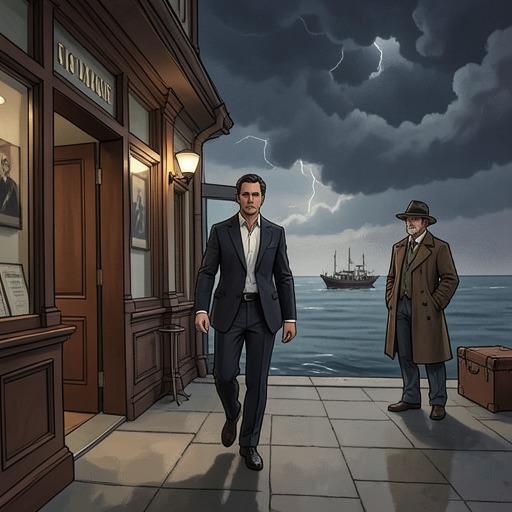
Adrian arrives by skiff from a steamer and steps ashore in Hokitika dressed with conspicuous care. He wears his best suit, has combed and oiled his hair, blackened his boots, and scented his handkerchief. Yet these efforts cannot disguise the physical effects of long dependence on alcohol: his eyes are pouched, his nose swollen, and his complexion permanently flushed. His stiff-hipped, lumbering walk, restless gaze, and yellow-stained fingers picking at his lapels make the polished appearance seem like a fragile surface over accumulated damage.
After directing his luggage to a hotel on Camp-street, Adrian thanks the oarsmen gruffly and walks the length of Revell-street, examining shop windows and studying passers-by without smiling. His progress is marked by watchfulness rather than sociability. The crowd outside the Courthouse has already dispersed, and the armoured carriage carrying Francis Carver’s body has returned to Seaview; Adrian barely looks at the locked building as he passes. His immediate purpose lies elsewhere: finding Walter.
The Search for Walter
At the Hokitika Post Office, Adrian joins the queue and takes a piece of paper from his wallet. When he reaches the postmaster, he asks for the letter to be delivered to Walter Moody. He does not know where his son is staying, only that Walter is in Hokitika, and identifies himself plainly as Walter’s father when asked about their connection. The postmaster agrees to have a boy look for him, requiring a shilling as surety and explaining that some of it may be reimbursed if Walter is found the next day.
Adrian steps aside as instructed, smooths the letter on the counter, and pushes it closer to the light. The postmark dates it 27 April 1866, the same day he has arrived in town. Rather than seek Walter out directly, he places the first approach in writing, asking his son to read to the end before judging him. That appeal for a hearing establishes the letter’s central tension: Adrian wants forgiveness, but knows that his history gives Walter reason to withhold it.
Debt, Drink, and Confession
In the letter, Adrian says that debt alone drove him to leave the British Isles. Frederick Moody, Walter’s brother, had heard that prospects were good at the Lawrence field in Otago and had decided to go there. Walter was in Rome and intended to spend the winter on the continent. Adrian chose to make the journey secretly, hoping to return rich before the year was out. He admits that his decision was also prompted by a desire to escape several men in London and Liverpool, a motive he describes as shameful rather than disguising it as a practical necessity.
Before leaving, he set aside £20 for his wife, the very last of his savings. He later learned that the money never reached her: the bearer, Piers Howland, had stolen it. By the time Adrian discovered the theft, he was already in Otago. The letter offers this betrayal as part of his account of departure, but does not erase his own responsibility for leaving secretly or for the debts that prompted him to go.
Adrian also explains that his recent dependence on drink had obscured and distorted his true intentions. He now says he has sworn never to drink again and that he has not broken the oath. He presents his letter as an act of repentance and describes himself as sober. His promised change is therefore both a personal claim and the condition he proposes for renewing family ties: if Walter allows another meeting, Adrian promises that it will be conducted without alcohol.
Family Reckoning and Narrative Role
Adrian asks forgiveness from Walter and from Frederick, joining his sons in a single appeal for reconciliation. The request is tentative; he speaks of a reunion only if Walter grants one, and closes by wishing him good fortune. The restrained hope of that closing contrasts with the practical failure of Adrian’s earlier attempt to provide for his wife: money intended as support was stolen, while the letter now carries the burden of making amends through words.
After reading the letter twice, Adrian folds it into its envelope and writes Walter’s name in large letters across the front. His hand trembles as he caps his pen. The gesture makes the letter at once a message and a test of his resolve: he can prepare an honest account and send it into the world, but he cannot control how his son will receive it. Adrian’s appearance, careful presentation, and repeated appeal for judgment held in reserve keep the hoped-for reconciliation uncertain. His arrival gives Walter’s family history a living presence, while leaving the outcome of their prospective reunion unresolved.